How to Choose a Sectional Sofa
Learning how to buy a sectional couch starts with measuring your room and delivery route, then matching the layout and seat size to your daily routine. Check cushion care, connections and setup before choosing extra features.
On this page (9 sections)
- How to buy a sectional couch that fits your room
- Which sectional layout should you choose?
- Which seat depth and height suit the way you sit?
- What upholstery and cushion care should you check?
- Do you need storage, a sleeper or movable pieces?
- What should you plan for delivery and assembly?
- How do you care for a sectional after setup?
- Which mistakes should you avoid before ordering?
- How to buy a sectional couch you will use well
To learn how to buy a sectional couch, measure your room and delivery route first, then choose a layout and seat size that suit your daily routine. Check cushion care, connections and setup before paying for extra features.
Start with the people who will use it most. A household that sits upright to talk needs something different from someone who curls up for long movies.
The right sectional should leave room for everyday movement, offer useful seats and fit your cleaning habits. For a broader look at styles, read our sectional sofa buying guide.
How to buy a sectional couch that fits your room
Buy a sectional whose full footprint fits around your daily routes, including the chaise and any separate ottoman. Measure the delivery route as a separate task, since room fit does not prove that the pieces can get inside.
Mark the whole shape on the floor
Measure the available width and depth, then use painter's tape to outline the sectional. Include projecting arms, the chaise and the ottoman in the positions where you expect to use them.
Leave your other furniture in place while you check the outline. Open nearby doors, pull out dining chairs and walk from the entrance to the places you use most.
Aim for about 30 to 36 inches of clear space along a main walkway where possible. A narrower gap may work beside an occasional-use seat, but it should not become the household's main route.
If you use a mobility aid, measure the space you need to pass and turn comfortably. Check access to the seats themselves, rather than measuring only the gap behind the sofa.
Our sectional sofa dimensions guide explains which measurements to compare when a chaise or deep seat changes the footprint.
Measure the delivery route separately
Record the narrowest doorway, hallway, stair landing and elevator opening between the entrance and the room. Include tight turns and overhead limits, such as a low stair ceiling.
Compare access with package or individual module dimensions, not just the assembled couch width. A doorway's width alone cannot tell you whether a bulky piece can turn through it.
Check whether delivery ends at the curb, building entrance or room of choice. Arrange help for lifting if needed, and confirm building delivery hours or elevator rules before choosing a delivery date.
Which sectional layout should you choose?
Choose an L shape when it fits the room's traffic pattern, and choose movable modules when you need more than one arrangement. Decide where the sofa should go before deciding how many sections to buy.
A corner placement can leave the center of the room open. Floating a sectional can divide an open-plan room, but you must allow a route around its back or ends.
A U shape brings people around 3 sides and can suit group seating. It also occupies more of the room's center, so check that the extra seats justify the space.
Count usable places rather than relying only on a seat count. A corner position or chaise may be someone's favorite lounging spot without working as a separate upright seat during gatherings.
How to buy a sectional couch with the right orientation
Choose the chaise side by looking at the room's main walkway and viewing direction. Use the layout diagram to confirm orientation, since left-facing and right-facing terms can be described from different viewpoints.
Place a box where the chaise would end, then walk around it with a laundry basket or shopping bags. This makes an awkward turn easier to notice than looking at an empty floor.
A reversible chaise lets you change sides, but it does not always mean every seat can move independently. Compare those designs in our guide to sectional versus modular sofas.
For help placing the sofa around a TV, windows or adjoining rooms, see how to arrange a sectional sofa.
Which seat depth and height suit the way you sit?
Choose seat depth for your posture and seat height for getting in and out. Overall couch depth includes parts such as the back and arms, so it is not a substitute for usable seat depth.
Measure a chair or sofa you already find comfortable. Note whether you can rest against its back with your feet supported, or whether you need a pillow behind you.
Deeper seats suit curling up and lounging, while a shallower sitting area can make upright conversation easier. In a shared household, a deep sofa with supportive back pillows may offer a workable compromise.
A low seat deserves special attention if anyone finds standing from low furniture difficult. Soft cushions can also compress under your weight, so the stated seat height is only part of the comfort decision.
Korser: choose it for low, deep lounging
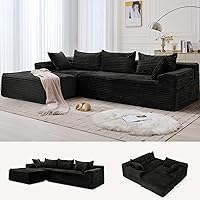
The Korser 110 L-Shaped Modular Sectional suits buyers who want low seating and separate pieces they can rearrange. It has 3 independent modules, and its armless seat can work as a standalone chair.
Its seat is 30.08 inches deep and 14 inches high. Those proportions favor stretching out, so skip it if your priority is sitting upright with little need for back pillows or rising from a taller seat.
The full layout is 110 inches wide and about 68 inches deep. Treat it as a substantial footprint even though the modules move separately.
Korser uses corduroy upholstery with foam cushions and side pockets. Its nonremovable seat covers make it a better fit for buyers comfortable with surface cleaning than those who require washable seat covers.
Furmax: choose it for soft fabric seating
The Furmax Chenille Sectional Couch suits buyers who want chenille upholstery and soft cushions. Its solid wood frame and high-density sponge fill provide a more useful basis for comparison than appearance alone.
Furmax gives a total weight capacity of 650 pounds. Compare that with the combined load you expect, rather than assuming the capacity applies to each seat.
Skip it if you need confirmed dimensions before narrowing your choices or if washable seat covers are essential. Furmax's care details conflict on seat-cover removal, so that point needs confirmation before you rely on it.
What upholstery and cushion care should you check?
Choose upholstery by how you will clean it and who will use it, then consider color and texture. Fabric names alone do not establish stain resistance, scratch resistance or washing instructions.
Corduroy has ridges that can catch crumbs and hair, while chenille has a textured surface that needs suitable care. Use the sofa's care label to choose a cleaning method rather than assuming either fabric can handle water.
Removable cushions and removable covers are different features. A cover that unzips is not automatically machine washable, and a removable back cushion does not prove that the seat cover comes off.
For children or pets, think through your most likely mess. Frequent food spills may make washable covers a priority, while pet hair may call for regular vacuuming and a suitable lint tool.
Korser says pet hair stays near the corduroy surface for removal with a lint roller or wipe. Follow the care instructions before using a damp cloth or cleaning solution.
Vogue: choose it for movable storage
The Vogue 109 L-Shaped Sectional With Storage Ottoman suits buyers who want a separate footrest that also stores household items. The ottoman can serve as an extra seat, allowing a different arrangement when guests visit.
Its assembled dimensions are 109 inches wide, 60.23 inches deep and 34.25 inches high. Tape out both the sofa arrangement and the ottoman's alternate position so that flexibility does not create a blocked walkway.
Vogue Furniture Direct says the beige fabric is breathable and OEKO-TEX Standard 100 certified. That certification does not mean the upholstery is stainproof or machine washable, and the seat cushion covers are nonremovable.
Choose it if blankets and pillows need a home near the seating area. Skip it if you need washable seat covers or cannot spare floor space for the ottoman when it moves away from the sofa.
Do you need storage, a sleeper or movable pieces?
Buy an extra feature only when you can name how you will use it. Storage, a guest bed and movable seating solve different problems and need different clearances.
For storage, measure the items you want to put away and check the compartment's usable interior. A large ottoman does not necessarily have enough internal space for a bulky comforter.
Leave room to lift or open its lid without moving the coffee table every time. Avoid storing damp blankets or overfilling the compartment so that the lid no longer closes freely.
A chaise or rearranged foam modules can provide a place to lie down, but that is different from a pull-out bed. If overnight use is essential, confirm the sleeping dimensions, surface and conversion method.
For modular seating, check whether each piece is finished for standalone use and which arrangements the connectors allow. Flexibility matters most when the alternate layouts are useful in your actual room.
Our guide to how to keep a sectional couch together covers the connection issue to consider before choosing separate sections.
Shintenchi: choose it for a compact footprint
The Shintenchi Upholstered Sectional With Storage suits buyers who want a reversible chaise and storage in a narrower layout. It measures 76.5 inches wide, 52.6 inches deep and 33.7 inches high.
Its wood frame has metal supports, and the upholstery is carbon black corduroy. Choose it when a compact L shape fits better than a wider sectional.
Skip it if several adults need generous separate sitting spaces. Its 3-seat description should not replace checking the usable seat area and how much room the chaise occupant takes.
If your room outline still feels crowded, compare alternatives in our small sectional couch guide.
What should you plan for delivery and assembly?
Plan for unpacking space, assembly and cushion expansion, rather than expecting every sectional to be ready immediately. Keep your old seating until you know when the new couch will be usable, if space allows.
Korser arrives vacuum-packed without furniture assembly, and the brand allows 24 to 48 hours for expansion. Clear enough floor space for the pieces to regain their shape without being wedged against other furniture.
Furmax ships in 2 packages that may arrive separately. It allows 48 hours for cushion expansion, so confirm that both packages have arrived before treating a missing part as a packing error.
Vogue includes tools, hardware and instructions for assembly. Its compressed cushions need fluffing after unpacking, while Shintenchi describes tool-free assembly in about 20 minutes.
Treat short assembly estimates as task guidance, not a schedule for the whole delivery day. Carrying boxes, checking parts and clearing packaging take additional time.
Before unpacking, photograph damaged boxes and check the parts against the instructions. Keep hardware in a tray, open packaging carefully and avoid cutting close to upholstery.
Assemble near the final position on a protected floor. Align connectors as directed, and move sections separately when needed rather than dragging the full couch by one arm.
How do you care for a sectional after setup?
Use regular light cleaning and prompt spill care to keep routine dirt from building up. Follow the upholstery care label before choosing products or applying moisture.
Vacuum seams, cushion gaps and fabric ridges with a suitable upholstery attachment. Remove grit before it gets rubbed into the fabric by daily use.
Blot a spill with a clean cloth instead of scrubbing it across a larger area. Check any approved cleaner on a hidden spot first, and avoid soaking foam or fabric.
Rotate or swap cushions only when their shape and instructions allow it. Do not force attached cushions loose or assume every modular seat has interchangeable covers.
Check connectors and accessible fasteners after moving the sofa. Keep the storage lid area clear, and avoid lifting a section by a cushion, pocket or unsupported edge.
Which mistakes should you avoid before ordering?
Avoid choosing by overall width, appearance or feature count alone. The most costly mismatch is often a couch that fits on paper but disrupts how you use the room.
Do not call a sectional compact just because its modules are small. The combined layout, chaise and walkway space determine how much room it uses.
Do not assume a deep seat will suit everyone or that a soft feel means an easy seat to rise from. Compare posture and access needs for the people who will use it daily.
Check return terms before payment, including packaging requirements, collection arrangements and return shipping costs. Compressed furniture may be difficult to repack once expanded.
Use this final checklist to compare your shortlist without repeating every feature.
| Decision | What you need to confirm |
|---|---|
| Room fit | Taped outline leaves useful seats and clear routes |
| Delivery | Packages can pass through doors, turns and stairs |
| Orientation | Chaise stays clear of the main walkway |
| Comfort | Seat depth and height suit your usual posture |
| Care | Cover removal and cleaning method match your needs |
| Features | Storage or sleeping space solves a specific need |
| Setup | You have help, floor space and expansion time |
| Returns | You understand collection, packaging and costs |
How to buy a sectional couch you will use well
The final step in how to buy a sectional couch is choosing the model that passes your room, comfort and care checks. Let those needs settle close choices.
Choose Korser for low, deep lounging with independent modules, or Vogue when a movable storage ottoman has a clear role in your room. Choose Furmax for soft chenille seating after resolving fit and cover-care questions.
Choose Shintenchi when a narrower footprint and reversible chaise matter most. If none passes your taped-floor check, reduce the sofa size before giving up your main walkway.
Take your measurements and nonnegotiable features to our sectional couch picks to build a shortlist that fits your home.
Frequently asked questions
How do I know what size sectional couch to buy?
Buy a sectional whose full footprint leaves your usual routes and nearby doors clear. Mark its width and depth on the floor, including the chaise or ottoman, then walk around the outline.
Measure the delivery route separately, because a couch that fits the room may still be difficult to bring inside.
Should I buy a left-facing or right-facing sectional?
Choose the side that keeps the chaise out of your main walkway and gives you a useful view of the room. Check the layout diagram because brands may describe orientation differently.
A reversible chaise helps if you need to switch sides, but confirm how that change works before ordering.
Is a modular sectional better than a fixed sectional?
A modular sectional is better if you expect to rearrange your room or move, while a fixed layout suits a settled furniture plan. Check whether each module works alone and how the sections connect.
Separate pieces give you options, but their combined footprint still needs to fit your room.
What should I check before buying a sectional couch?
Check the room footprint, delivery access, seat depth and height, cushion care, connections and setup requirements. Then review any storage or bed-opening space you need.
Before paying, confirm delivery arrangements and return terms, including whether you must keep the packaging or pay to send large pieces back.
Are sectional couches good for small rooms?
A sectional can suit a small room when it uses a corner without closing off the main walkway. Compare its taped footprint with a sofa and separate chair, and count the seats people can comfortably use.
A compact design with the right chaise orientation matters more than a small-space label.